Tuesday, October 19, 2010

1962, October 27


(above) The Beatles with interview Monty Lister

In an interview given this date (just before they were to go onstage at Hulme Hall, Birkenhead), the boys were still at the precipice of immortality, and quite unaware of it, as their honest repartee with interviewers Monty Lister, Malcolm Threadgill, and Peter Smethurst clarifies. There is quite a bit good information given as responses to questions, and the early date (not to mention the lads’ decidedly sincere manners) is good cause to believe their statements as fact rather than deliberate myth. The interview was broadcast only over closed-circuit radio broadcast (a show called Sunday Spin) for two hospitals at Cleaver and Clatterbridge, another interesting facet. As the approximately-7m interview comes to a close, John plugs the song that will be aired over hospital speakers (“Love Me Do”) by announcing the catalog number (“Parlophone R4949”), after which Ringo chimes in, “Buy it, folks.”

(ref: Winn, Way Beyond Compare)

_______________________________________________________________________

AUDIO SOURCE: First available as a flexi-disc extra included with Lewisohn’s book, The Beatles Live!, it has since been widely available on bootleg, most recently on Purple Chick’s Strong Before Our Birth.

You can hear the interview: here. A transcript is: here.

VIDEO: None.

_______________________________________________________________________

Tom Wise
gengar843@msn.com

Although I use quotes from sources, or cited fact, much of the material on this and other pages of my blog is original, from my own pen. This is not cut-and-paste, it is a work of art. Copyright © 2010 Tom Wise

1962, October (circa)


(above) John and Paul work on "I Saw Her Standing There" (photo: Mike McCartney)

BACKGROUND

After opportunity began knocking (about April of 1960), The Beatles became one of the hardest-working bands out there. They played every possible date, sometimes doing two or three shows on a particular day. In 1961, they performed approximately 270 days out of 365, and it’s safe to say that these amounted to over 320 shows. The year 1962 was more hectic, with close to 290 concert dates, totaling about 350 shows1.

THE TAPE HISTORY

On a particular day in the fall of 1962, the boys gathered (as it probably seemed to them they always did) at the Cavern Club in Liverpool, in order to rehearse and/or write material before their evening show. Since their schedule was too jammed for the more casual rehearsal (which had in times past been held at someone’s home), this was not an unusual occurrence. The exact date of this rehearsal is uncertain, but there are clues. First, Ringo is the drummer (his voice is heard on the tape), so it was no earlier than August 15. Second, a famous photograph taken by Paul’s brother, Mike, dated September 1962, shows John and Paul at work on “I Saw Her Standing There,” in front of them a notebook of the lyrics and chord changes2. But this rehearsal included a more-advanced version of that song, seeming to indicate that the photo came before the tape. Third, by the time the lads played Hamburg in December of 1962, “I Saw Her Standing There” was finished. Thus, the tape must date after August 15 (likely after September) but before December 16 (the last date the Beatles played the Cavern in 1962).

Allegedly, a jazz musician discovered this tape. Winn concluded that perhaps the same jazz musician recorded this Beatles' practice session, even played the Cavern that same night. Indeed, jazz bands played on the same Cavern bill as The Beatles. However, Winn limited the dates of possibility to September 23, September 30, and October 7, 1962. Several things here: (1) accepting that a jazz musician was present during the rehearsal doesn't necessarily mean that a jazz band was playing the night this tape was made. Bramwell, for example, wrote that the Cavern itself had been in times past a jazz club3, so that a jazz musician would not be an odd patron there at any time, (2) The Beatles actually played with jazz bands at the Cavern on many more dates in 1962 than permitted by Winn. The full list also includes September 2, 9, and 16, October 13, November 18 and 25, and December 9 and 164. It is therefore impossible to say whether this tape belongs to September, October, November, or even December.

My own arbitrary reason for choosing October is that the tape sounds to me like a nice autumn Sunday afternoon (warm hug).

Some sources (for example, Allen J. Wiener's The Ultimate Recording Guide) think this tape recorded in March or April of 1962, but such a claim appears to be impossible.

1 Lewisohn, The Beatles Live!

2 Coleman, Lennon (1985), p.85

3 Bramwell & Kingsland, Magical Mystery Tours, p.51

4 Miles and Badman, The Beatles: The Beatles Years

CATSWALK HISTORY

Paul wrote “Catswalk” ca. 1958-591,2. This song became one of those that Lennon and McCartney “gave away.” In 1967, The Chris Barber Band* recorded it and renamed it “Catcall” for their 45 (Marmalade 598-005), which did not chart.

* The Chris Barber Band had formerly been known as The Chris Barber Jazz Band. It's not known if any member of The Chris Barber Jazz Band recorded and/or found the 1962 rehearsal tape.

1 Davies, The Beatles, p.61

2 Lewisohn, Chronicles, p.362

________________________________________________________________________

TRACKS:

“I SAW HER STANDING THERE”

“ONE AFTER 909” (called “take 1”)

“ONE AFTER 909” (called “take 2”)

“CATSWALK” (called “take 1”)

“CATSWALK” (called “take 2”)

________________________________________________________________________

AUDIO SOURCES

Winn and Sulpy both noted the 1990 Japanese bootleg CD The Cavern Tapes Circa 1962 (details: here) as the most complete source. However, the cleanest source is the slightly-clipped Ultimate Collection, Vol. 1. Purple Chick combined these, squeezing out every sound at the best quality, for the bootleg Strong Before Our Birth.

Following is a comparison of the material from source to source:

The Cavern Tapes Circa 1962. Pending (I accept donations).

Ultimate Collection 1. Begins with Paul counting off, "1-2-3." "I Saw Her Standing There" commences. Volume drop from 1:49 until 1:52. Ends faded with Paul warbling "I saw her standing there," followed by harmonica and a stray guitar note. The first instance of "One After 909" commences, entering mid-song. Ends with a bass run. John is heard, "Got that beginning still?"*, followed by an edit, John then counting in "a-1-2-3-4." The second attempt at "One After 909" commences. Ends with a barrage. Someone momentarily scats "da-da." Paul says, "OK...k...1-2-3-4." The first performance of "Catswalk" commences. Ends normally. Paul says, "Everyone (?), try this, 1-2-3-4." Following, sounds like an edit, with someone saying a word (can't make it out), and Paul replying, "Yeah, 2-3-4." The second take for "Catswalk" commences. Ends with random guitar arpeggio.

Ultimate Collection, Vol. 1 tracks are: here.

Strong Before Our Birth. (difference to UC1 in italics) Begins with Paul counting off, "1-2-3." "I Saw Her Standing There" commences. Speed-corrected +3%. Volume drop fixed. Ends faded with Paul warbling "I saw her standing there," followed by harmonica, a stray guitar note, and about five more seconds of guitar and drums. The first instance of "One After 909" commences, entering mid-song, but one second earlier. Speed-corrected +3%. Ends with a bass run. John is heard, "Got that beginning still?"*, followed by an edit, John then counting in "a-1-2-3-4." The second attempt at "One After 909" commences. Speed-corrected -1%. Ends with a barrage. Someone momentarily scats "da-da." Paul says, "OK...k...1-2-3-4." The first performance of "Catswalk" commences. Ends normally. A moment of mumbling, or off-mike discussion. Then, sounds like an edit. Paul says, "Everyone (?), try this, 1-2-3-4." Following, sounds like an edit, with someone saying a word (can't make it out), and Paul replying, "Yeah, 2-3-4." The second take for "Catswalk" commences. Ends with random guitar arpeggio.

* It sure does sound like "Got that beginning, Stu?"

VIDEO SOURCES

None.

_______________________________________________________________________

RELATIVES: An entire webpage dedicated to “Catswalk,” and Chris Barber’s relationship to The Beatles, is: here.

RELATIVES: Keep up with Mike McCartney: here.

_______________________________________________________________________

Tom Wise
gengar843@msn.com

Although I use quotes from sources, or cited fact, much of the material on this and other pages of my blog is original, from my own pen. This is not cut-and-paste, it is a work of art. Copyright © 2010-11 Tom Wise.

Sunday, October 17, 2010

Sonic Hierarchy: Please Please Me LP STEREO

ANALOG HIERARCHY

ABBREVIATIONS KEY

For basic information concerning mastering procedures and terminology, go to my simplified guide: here.

BC-1 = The Collection (MFSL BC-1), aka "The Black Box"

BC-13 = The Collection (Parlophone BC-13), aka “The Blue Box”

HTM = mastered by Harry T. Moss

Ma = Matrix #

MFSL = Mobile Fidelity Sound Labs (MFSL 1-101)

P = Pressing

PS = Parlophone Stereo (PCS 3042)

SS = Solid State-cut

TC = Tube-cut

TH = Thin vinyl

THE SHORT STORY (for Experts)

There is a marked difference between masters. UK Mastering is "wetter" than one specific German Stereo master (dead wax information SHZE-117-A-2/B-2). You need both, although it's said that once you hear the latter you will never again desire the former. Full details below.

Both US versions (Vee-Jay and Capitol) were abridged. The Early Beatles has extra reverberation.

Part 1: UK Mastering

BACKGROUND INFORMATION

General Information. The Stereo release of Please Please Me (Parlophone PCS 3042) was issued on April 26, 1963. More general album information: here.

Misnomer. "UK Mastering" applies to many other worldwide releases, including the first German lacquer.

Distinguishing Marks. As documented on the tape box (pictured on the MFSL album cover), UK Mastering used a certain amount of additional EQ and/or compression. The "Specific German Mastering" lacks some of this post-processing, as detected by comparisons on reverberation (this "echo" is an illusion caused by the extra compression).

Intent. This “wet” UK Mastering appears to have taken place as the UK LP reel was mastered for lacquer. The reason seems to have been to equalize the sound quality throughout the album, some songs having apparently been too “dry” for George Martin’s taste. Whether in hindsight we wish to say that the “wetness” was a good or a bad decision, it has in any case given us two distinct listening experiences.

UK LP Please Please Me (1960's) - all labels

****

$50-24,000

(left to right) Yellow & Black, One-Box, Two-Box labels

PS, Ma = YEX-94-1/95-1, TH (one-box and two-box labels), TC.

Lacquers remain TC, -1/-1 until P9, which is the final -1/-1 lacquer and the only two-box with that lacquer (look for “Made in Gt. Britain” printed beneath the lower “EMI” box).

Yellow & Black is often found in worn condition or overpriced (the high price parameter reflects rare early pressings, which are not necessary even for audiophiles). One-box is easier to find in excellent condition and is less expensive (bang for the buck). Two-box is harder to find with -1/-1 lacquer.

The mother changes to "2" about P6, so that is a window of opportunity for a “hot stamper” to be discovered.

Box Set The Beatles Collection (1978-on) - "Blue Box"

*** + to *** ½

$150-300 box set

PS (within BC-13), Ma = YEX-94-3/95-2 (common), HTM (possible), TH, SS.

General Information. This was a worldwide release. A two-box, later lacquer Please Please Me LP is most commonly found inside the box. This is more than adequate for most listeners.

Sonic Information. UK is considered the best pressing, followed by Germany, Sweden and New Zealand (experts may differ). "HTM" in the dead wax makes this jump from *** + to *** ½, or about 80-90% of TC sound.

Japan (MFSL) LP Please Please Me (1986)

*** + to *** ½

$50-100

MFSL 1-101 (also within BC-1), Ma = various (A1 is first stamper, A1-1 is second stamper).

Many swear by MFSL. Sonic experience is actually variable.

NOTES

(1) If you thought the Mono issue of Introducing the Beatles was rare and expensive, try seeking out the Stereo (Vee-Jay SR-1062). In any event, this release is incomplete (12 of 14 songs). More general information: here.

(2) The Early Beatles Stereo LP (Capitol ST-2309) is incomplete (11 of 14 songs) and has extra reverberation, making this source actually full of Variations, and not a replacement for Please Please Me.

(3) The Stereo Japanese red wax edition has, to my ears, inferior sound, and is thus not an acceptable substitute for rated sources.

______________________________________________________________________

Part 2: Specific German Mastering

BACKGROUND INFORMATION

Visual Identification. This master is only to be found on certain German LP’s, specified below. Check the matrix identification, as follows: Side 1 should have “SHZE-117-A-2” in the dead wax, and side 2 should have “SHZE-117-B-2.” Any matrix identification ending "-1" is not this desirable master, but is the UK Mastering. Pictured below are two known 1964 German issues with the “-1” (incorrect) matrix (verified).

(left) thick-vinyl Die Beatles;

(right) export-only Please Please Me (Odeon ZTOX 5550), circa 1963-1964.

Sonic Identification. The Specific German Mastering is a “dry” master. It lacks the extra compression which was applied to the UK master, and, consequently, some of the tracks here have somewhat less perceived reverb, and a natural quality that makes it seem as if you’re in the studio with the boys. Excellent tonal features and lots of “air" on those affected tracks. To hear some comparisons between Die Beatles and other releases, click: here.

Note that the UK LP does not use the feared “modern digital compression” but the “warm gushy kind of compression” and it's the way The Beatles, or at least George Martin at this point in their career, wanted it to sound, not to mention the sound that listeners first heard and loved in 1963. The German LP is thus an addendum to, not a substitute for, the UK.

Intent. It would appear to be obvious, since there was a first German Stereo lacquer (“-1”) which sounds rather like the UK Mastering, that processing instructions had been sent to Germany along with a dub of the UK production master, and that these instructions had been initially followed. But, when it came time for the reissue on the Hör Zu label, a new lacquer (“-2”) was cut (from the same production master), and it seems just as obvious that the processing instructions were then ignored. Now, whether this was done accidentally (oversight) or deliberately (the mastering engineer decided to make his own Beatles record, for whatever reason), I do not know.

There is some argument over whether EMI sent unprocessed production masters (plus instructions) to countries other than Germany. Of course, this would appear to be logical standard procedure. Others believe that EMI sent separate already-processed production masters to each country, but this seems more difficult. Either way, an unprocessed production master (that is, lacquer “-2”) was certainly not what EMI had in mind for Germany.

Die Beatles (1966-on)

****

$50-100

(center) label circa 1966-68;

(right) label circa 1973.

TH (thinner vinyl than the 1964 "-1" lacquer)

Germany LP Please Please Me (1969 and 1977)

*** ½

$20-80

(left) Apple/Electrola 1C 062-04219 and 1C 072-04219;

(center) Odeon 1C 062-04219;

(right) typical label.

Apple/Electrola 1C 062-04219, and Odeon with the same catalog number, are 1969 releases. Apple/Electrola 1C 072-04219 is from 1977 (there does not seem to be a corresponding Odeon release).

______________________________________________________________________

DIGITAL Hierarchy

Please Please Me CD LP Remaster (2009)

****

The remaster is a superior product, with excellent clarity and definition, and gobs of low and top end. In comparison to other sources, the remaster wins many times.

Reported that the UK, Germany, and/or Japan release may be mastered with more clarity and/or warmth than the US or Canada issue.

______________________________________________________________________

BOOTLEG Hierarchy

The best Please Please Me analog-to-digital rips emanate from Dr. Ebbetts and pbthal ("Tube-Cut"). These audiophiles used superb equipment, passion, and a good ear, so it might be worth your time to seek them out, especially since it can be a chore to find a good-quality vinyl pressing at a decent price.

_______________________________________________________________________

Tom Wise
gengar843@msn.com

Although I use quotes from sources, or cited fact, much of the material on this and other pages of my blog is original, from my own pen. This is not cut-and-paste, it is a work of art. Copyright © 2010 Tom Wise.

Friday, October 15, 2010

Vee-Jay and The Beatles

ARMS THAT LONG TO HOLD YOU: The Beatles and Vee-Jay Records: A Short Story.

It was early 1963. Capitol Records had shown no interest in The Beatles, and so Vee-Jay Records was given the right of first refusal on Beatles records in America for the next five years. On February 7, 1963, Vee-Jay proudly released the 45 “Please Please Me"/ "Ask Me Why” (VJ 498). They were promptly disappointed by a less-than-rousing US reception.

Back in England, The Beatles were one of 15 acts to play at “Swinging Sound ’63,” an all-star concert at Royal Albert Hall in London, on April 18, 1963. Included in this night’s set was “From Me to You.” Del Shannon was also on the bill, and, after the show, he indicated to John that he wanted to record “From Me to You” to give the group some exposure in America. “At that time no one had heard of the Beatles here (the U.S.), but I knew they were great writers so I just picked up on one of their songs”1. At first, John was flattered and (with Paul) agreed, but somewhere along the line (after the die was cast and the papers were signed) he changed his attitude, believing instead that a cover version might hurt The Beatles’ chances of having a hit in the States.

1 lifeofthebeatles.blogspot.com/2008_05_25_archive.html

It’s not quite clear if a wary John influenced Vee-Jay in this regard, but the fact is that the record company issued the Beatles 45 “From Me to You”/ “Thank You Girl” (VJ 522) on May 7, 1963, before Del Shannon’s single was finished. Despite John’s intuition (or perhaps his paranoia), this 45 failed even more so than the previous one, selling less than 4000 copies through June of 1963.

Meanwhile, Shannon completed his recording, and released “From Me to You” (b/w “Two Silhouettes”) in June of 1963 (Big Top BG-1371). It turns out that Shannon was right after all, because his version was a minor hit, scoring to #77 on the Billboard charts in the summer of 1963. In fact, this made Shannon the first artist to chart a Lennon-McCartney composition in America, even before The Beatles!

When Del Shannon’s version began to get a little steam, Vee-Jay tried to capitalize by placing magazine ads for, and by sending out promotional copies of, VJ 522, stamped with the words “The Original Hit" (Billboard, June 8, 1963). Dick Biondi, a Los Angeles DJ, and a Beatles believer from the start of the year, received one of these promos, and convinced his bosses at radio station KLRA to add “From Me to You” to their playlist. It entered that station’s “Tune-Dex” on July 14, 1963, a momentous occasion. Suddenly, The Beatles were getting airplay and, due to this, an actual Beatles release for the first time cracked into the US charts. By August 10, “From Me to You” was #116 on Billboard's “Bubbling Under” list. But it was a small victory; sales of VJ 522 only increased to about 22,000 copies.

PAUL: “‘From Me To You’ was released - a flop in America” 2.

JOHN: “The thing is, in America, it just seemed ridiculous - I mean, the idea of having a hit record over there. It was just something you could never do. That's what I thought, anyhow. But then I realised that kids everywhere all go for the same stuff; and, seeing we'd done it in England, there's no reason why we couldn't do it in America too. But the American disc jockeys didn't know about British records; they didn't play them, nobody promoted them, so you didn't have hits” 3.

2 The Beatles Anthology, p.115

3 Playboy interview, September 1980

Overseas, though, The Beatles remained white-hot. When With the Beatles shot straight to #1 in England on November 30, 1963 (unseating Please Please Me, which had held that top spot for the previous 30 weeks!), Capitol Records could no longer deny the band’s power, even as Vee-Jay releases, including the first issue of the LP Introducing the Beatles (VJLP 1062, distributed in late July 1963), failed to make any dent. As an arm of EMI, Capitol had the right to unseat Vee-Jay (as well as Swan and Tollie) for the American distributorship. Thus, in early December 1963, Capitol began to launch a huge campaign promoting The Beatles and a forthcoming Capitol release, “I Want to Hold Your Hand”/ “I Saw Her Standing There” (Capitol 5112, released December 26, 1963).

The management of Vee-Jay Records, exercising their own contract rights, continued to pump out product, and paired “Please Please Me” with “From Me to You” for a planned repackage single (VJ 581). This was pressed on or about January 3, 1964, shortly after footage of The Beatles appeared on the Jack Paar Show. Capitol, informed of Vee-Jay’s impending move, was not amused. On January 15, 1964, they hit Vee-Jay with an injunction against manufacturing, distributing, advertising, or otherwise disposing of records by The Beatles. Capitol contended that Vee-Jay’s rights to the Beatles had been canceled on August 8, 1963, for nonpayment of royalties. Although Vee-Jay’s management denied it, a restraining order was granted. Calvin Carter, one of the founders and management team for Vee-Jay, said, “They were trying to get us on something really minor, like failure to declare royalties on 500 records we shipped in 1963. But that was not true at all.” Unfortunately, Vee-Jay was also involved in no fewer than 64 legal actions at the time. Carter recalled, “It’s frightening to think about it even now.” Surprisingly, a few days later, Vee-Jay had the order removed, and they went on a pressing binge.

First, promotional copies of VJ 581 were mailed to various outlets with a special picture sleeve that declared “The Record That Started Beatlemania” and advertised The Beatles’ upcoming appearance on The Ed Sullivan Show.

The official 45 was released on January 30, 1964. Coinciding with world-smashing events, and riding the crest with everyone else, the single rocketed to #3 on the Billboard chart, March 14, 1964.

Vee-Jay followed with a blitz of reissues and re-packages. In late January, 1964, the second version of Introducing the Beatles saw daylight. For this release, "Love Me Do" and "P.S. I Love You" were replaced (over a dispute with EMI-affiliated publisher Ardmore and Beechwood) with "Please Please Me" and "Ask Me Why."

On February 26, 1964, Vee-Jay packaged "Please Please Me," "From Me to You," "Ask Me Why," and "Thank You Girl" on the hybrid LP Jolly What! The Beatles and Frank Ifield on Stage (VJLP 1085). In fact, to capitalize on Beatlemania's urge to collect everything, this album was issued with two different covers, and the LP edged as high as #104 on the Billboard album chart.

The marketing continued as Tollie (a Vee-Jay subsidiary) paired two songs from the album, "Twist and Shout" and "There's a Place," onto a single (catalog #9001). This was delivered on March 2, 1964, and rose to #2 on the April 11 Billboard chart.

Riding on these coattails, Vee-Jay extracted "Do You Want to Know A Secret" from the album and issued it as a single with "Thank You Girl" (VJ 587), March 23, 1964. The A-side peaked at #2 on May 9, and the B-side crept up to #37 by April 25.

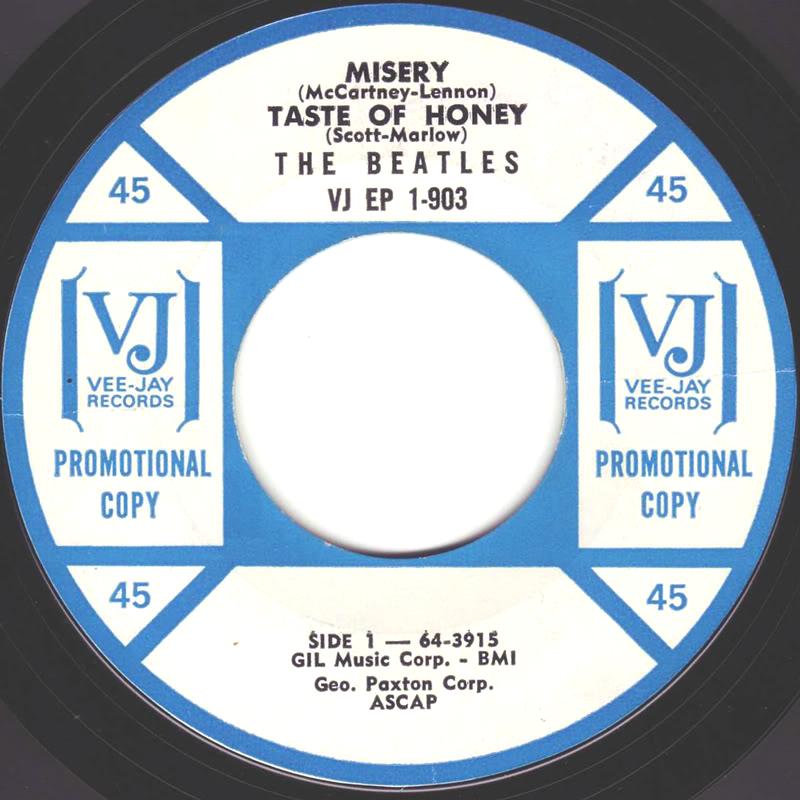
Also on March 23, "Misery," "A Taste of Honey," "Ask Me Why," and "Anna" were released on a repackage EP, entitled The Beatles: Souvenir of Their Visit to America (VJEP 1-903).

Not letting the grass grow under them, Vee-Jay impressed "Love Me Do" and "P.S. I Love You" (now permitted for use due to an April 1964 settlement with Ardmore and Beechwood), as another subsidiary 45 (Tollie 9008), released April 27, 1964. "Love Me Do" made everyone proud by hitting #1 on the Billboard chart on May 30.

Vee-Jay actually planned to issue yet another EP (more like a single) in June or July 1964, but it was not to be, as the court case was re-opened. Nevertheless, a promotional disc (VJ 8, aka "Spec. DJ No. 8") was pressed in a short run, and this rarity is now considered one of the most valuable records of all time. A near-mint copy, presently in the hands of a collector, is worth at least $15,000. An excellent article detailing the discovery of VJ 8 can be found: here.

Vee-Jay's aggressiveness and extraordinary success caused Capitol to press their case swiftly. But, on July 23, 1964, Judge Mervyn A. Aggeler announced, “The court finds in favor of Vee-Jay Records on all the issues raised in their cross complaint. Vee-Jay Records has the unqualified right to advertise and promote the covered masters in any cover, jacket or package which Vee-Jay Records, Inc., deems appropriate.” The verdict, however, wasn’t global or permanent. Vee-Jay would only be allowed to release Beatles recordings for which they had already received masters, and only until October 15, 1964, after which they would retain no right to issue any Beatles product.

In a last-ditch effort, Vee-Jay mercilessly milked what they had. On August 10, 1964, they re-released four previous singles on the misleading “Oldies 45” subsidiary label. On September 4, having secured interview tapes from Jim Steck and Dave Hull, recorded August 24 and 25, 1964, Vee-Jay issued the LP Hear the Beatles Tell All (PRO-202, originally intended as a promotional-only issue). On October 1 came the double-album The Beatles vs. The Four Seasons (VJ DX 30), The Beatles' half of which merely included a copy of Introducing the Beatles (second version). Only 11 days later (October 12), Vee-Jay issued Songs, Pictures, and Stories of the Fabulous Beatles (VJLP 1092), yet another repackaging of Introducing the Beatles.

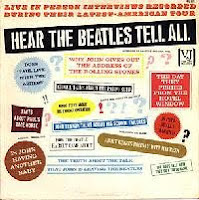
EPILOGUE: Thus ended the short and lively association between Vee-Jay and The Beatles. Vee-Jay’s fortunes dwindled over the years, as their legal and personal problems dogged them to the end.

_______________________________________________________________________

REFERENCES:

To see the masters, mothers, and stampers for many of these discs, go: here.

Castleman & Podrazik, All Together Now

Lewisohn, The Beatles Live!

Spizer, The Beatles Are Coming! The Birth of Beatlemania in America

Spizer & Livingston, The Beatles’ Story on Capitol Records Part 1

Whitburn, Top Pop Singles 1955-2008

_______________________________________________________________________

Tom Wise
gengar843@msn.com

Although I use quotes from sources, or cited fact, much of the material on this and other pages of my blog is original, from my own pen. This is not cut-and-paste, it is a work of art. Copyright © 2010 Tom Wise.